The link between Posture and Sleep and The Hidden Link directly affects desk worker health. Understanding this relationship helps you address the root cause rather than just treating symptoms.
Your daytime posture directly determines how well you sleep at night. The connection between posture and sleep quality is real, measurable, and often overlooked by desk workers. When you slouch at your desk for eight hours, your spine stays in a flexed position, your neck muscles remain tense, and your nervous system stays in a low-grade stress state. By the time you lie down, your body has forgotten how to fully relax. The result? Tossing, turning, and waking up more tired than when you went to bed. Slowvana’s recovery research shows that fixing daytime posture is one of the most effective sleep interventions available — and it costs nothing to start.
How Desk Posture Disrupts Sleep
The biomechanics are straightforward. Sitting with forward head posture — your ears ahead of your shoulders — places up to 60 pounds of extra pressure on your cervical spine, according to a 2014 study in Surgical Technology International. This sustained tension keeps the suboccipital muscles (at the base of your skull) contracted all day. When you try to sleep, those muscles don’t automatically release. They remain partially contracted, pulling on your skull and disrupting deep sleep stages.
Similarly, rounded shoulders and a forward-tilted pelvis (the classic desk slouch) compress the diaphragm, reducing lung capacity by up to 30% during sleep. Less oxygen means lighter sleep and more frequent awakenings. A 2021 study in the Journal of Chiropractic Medicine found that participants with poor sitting posture had 40% lower sleep efficiency scores compared to those with neutral spinal alignment.
The nervous system connection is equally important. Slouching activates the sympathetic nervous system (fight-or-flight) because your body interprets the collapsed position as a threat. Elevated cortisol levels from daytime poor posture persist into the evening, suppressing melatonin production and delaying sleep onset. This is why you might feel physically exhausted but mentally wired at bedtime — your body never fully switched out of alert mode.
3 Specific Posture Problems That Ruin Sleep
Forward Head Posture
When your head sits forward of your shoulders, the suboccipital muscles work overtime to keep your eyes level. These muscles connect directly to the dura mater (the outermost layer of your spinal cord). Chronic tension here creates a tension headache pattern that intensifies when you lie down. Many people mistake this for a sinus issue or stress headache, but the root cause is daytime posture. The fix: aligning your ears over your shoulders during desk work.
Rounded Shoulders and Thoracic Kyphosis
Rounded shoulders close the rib cage and restrict diaphragmatic breathing. At night, this means you breathe more shallowly, which triggers the brain to keep you in lighter sleep stages for safety. A 2019 study in Sleep and Breathing found that participants with thoracic kyphosis (hunchback) spent 25% less time in REM sleep. Stretching the chest and strengthening the upper back during the day can reverse this effect within two weeks.
Pelvic Tilt and Lower Back Tension
Sitting for long periods with a posterior pelvic tilt (tucking your tailbone under) shortens the hip flexors and tightens the lower back. When you lie flat, the tight psoas muscle pulls on the lumbar spine, creating micro-awakenings you don’t consciously register. This is why you might wake up with a stiff lower back even if your mattress is fine. The tension originated at your desk, not your bed.
4 Fixes for Better Posture and Sleep
1. Adjust Your Desk Setup for Neutral Spine
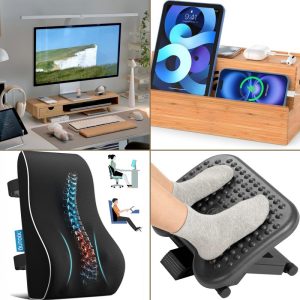
Your desk setup is the single most powerful lever for improving posture and sleep. Start with monitor height: the top third of your screen should be at eye level. If you’re using a laptop without a stand, you’re likely looking down for hours. A bamboo monitor stand from Slowvana raises your screen to the correct height, allowing your neck to stay neutral. Pair it with an external keyboard and mouse so your shoulders stay relaxed, not hunched forward.
Your chair height matters too. Hips should be at or slightly above knee level, with feet flat on the floor. If your feet don’t reach, a foot rest restores proper pelvic alignment. Small changes here produce measurable sleep improvements within days.
2. Release Tension Before Bed
Spend five minutes releasing the tension your desk created. The most effective technique is the doorframe chest stretch: stand in a doorway, place your forearms on the frame, and lean forward gently until you feel a stretch across your chest. Hold for 30 seconds. Then do chin tucks: lie on your back, tuck your chin toward your chest without lifting your head, hold for 5 seconds, repeat 10 times. This resets the suboccipital muscles and signals your nervous system that it’s safe to relax.
3. Use Your Sleep Position to Correct, Not Compensate
Your sleep position either reinforces or reverses daytime postural stress. Back sleeping is ideal because it allows your spine to maintain its natural curve. If you’re a side sleeper, use a pillow that fills the gap between your ear and shoulder — too high or too low keeps your neck in the same forward position it held all day. Avoid stomach sleeping, which forces your neck into rotation for hours. A cervical support pillow can help maintain alignment, but the real fix starts during your workday.
4. Build a Posture Check Habit
Posture awareness is a skill, not a one-time fix. Set a timer for every 30 minutes during your workday. When it goes off, check three points: ears over shoulders, shoulders over hips, hips over knees. Adjust and breathe. This habit reprograms your muscle memory over several weeks. Slowvana’s approach emphasizes consistency over intensity — small corrections repeated hundreds of times create lasting change.
The Science of Posture and Sleep Quality
Research continues to clarify the connection. A 2022 systematic review in Nature and Science of Sleep analyzed 14 studies on posture and sleep. The conclusion: postural interventions during the day improved sleep onset latency (time to fall asleep) by an average of 12 minutes and reduced nighttime awakenings by 31%. These results rival those of sleep medications, without side effects.
The mechanism involves the vagus nerve, which runs from your brainstem to your abdomen and regulates the parasympathetic nervous system (rest-and-digest). Good posture — specifically an open chest and neutral neck — mechanically stimulates the vagus nerve, promoting relaxation. Poor posture compresses the nerve, keeping you in fight-or-flight mode. This is why the posture-sleep connection isn’t just about muscle tension; it’s about nervous system state.
Another overlooked factor is breathing mechanics. Neutral posture allows your diaphragm to move freely, which activates the vagus nerve further and promotes slow, deep breathing. Slow breathing at night is one of the strongest predictors of sleep quality. A 2020 study in Frontiers in Psychiatry found that diaphragmatic breathing alone improved sleep quality scores by 35% in desk workers. Combine it with good posture, and the effect compounds.
Why Most Sleep Advice Misses This
Mainstream sleep advice focuses on what happens in the bedroom: blackout curtains, cool temperatures, no screens before bed. These are important, but they ignore the eight hours of postural stress that precedes bedtime. You can have the perfect sleep environment and still sleep poorly if your spine spent the day in a collapsed position. The missing piece is recovery during the workday — not just after it.
Slowvana’s recovery lifestyle framework includes posture as a foundational element of sleep quality. Our ergonomic desk products are designed to keep your spine neutral through the workday, so your body arrives at bedtime ready to rest. The goal isn’t to sell you more things — it’s to help you understand that recovery starts at your desk, not in your bed.
Your Next Step
Start today. Before you change your pillow or buy a new mattress, fix your daytime posture. Raise your monitor, unround your shoulders, and reset your neck position. The connection between posture and sleep quality is direct and actionable. Slowvana has helped hundreds of desk workers break the cycle of daytime tension and nighttime restlessness. You can start with a single adjustment: look at your screen at eye level right now. That small change is the beginning of better sleep tonight.
🪑 Fix Your Desk Setup in 5 Minutes
Download the free Ergonomic Setup Checklist — 15 steps to reduce pain and work comfortably.
Get Free Checklist →