For desk workers, understanding 60-Second Stress Relief at Your Desk is essential for maintaining comfort and productivity throughout the workday. Here is what the research shows and how to apply it.
Your Desk Can Be a Stress Trap — Here’s How to Escape in 60 Seconds
Workplace stress isn’t just a mental burden—it’s a physical one. When deadlines loom, your shoulders creep up toward your ears, your jaw tightens, and your breathing becomes shallow. Over a full workday, this accumulated tension can spike cortisol levels, impair focus, and even trigger chronic pain. But here’s the good news: you can reverse that spiral in under a minute. Research-backed 60-second stress relief techniques at your desk can lower heart rate, release muscle tension, and reset your nervous system without leaving your chair. Slowvana’s recovery philosophy is built on small, intentional actions that fit seamlessly into your workflow—not another task on your to-do list. Let’s walk through five techniques you can start using right now.
Why 60 Seconds Works: The Science of Micro-Recovery
Your body’s stress response is designed for short bursts—fight or flight was never meant to last eight hours. Yet modern desk work keeps your sympathetic nervous system (the “gas pedal”) activated for prolonged periods. The solution isn’t a 30-minute meditation session you’ll never schedule; it’s micro-recovery: brief, strategic pauses that activate the parasympathetic nervous system (the “brake pedal”).
A 2021 study in the International Journal of Environmental Research and Public Health found that just 60 seconds of slow, diaphragmatic breathing can reduce cortisol levels by up to 15% within five minutes. Another study from the American Institute of Stress showed that brief muscle relaxation exercises break the tension-pain cycle in office workers. The key is consistency—doing small things often beats doing big things rarely. That’s the core of Slowvana’s Recovery Lifestyle: integrating healing into your existing routine, not adding more to your plate.
Technique 1: The 60-Second Breathing Reset
When stress hits, your breathing becomes rapid and shallow, feeding more anxiety. The fastest way to calm down is to control your exhale. Here’s a 60-second protocol:
- 0–10 seconds: Inhale through your nose for 4 counts. Let your belly expand, not your chest.
- 10–20 seconds: Hold gently for 4 counts.
- 20–60 seconds: Exhale slowly through your mouth for 6 counts. Repeat four times.
Why it works: Lengthening your exhale stimulates the vagus nerve, which signals your brain to relax. A 2018 meta-analysis in Frontiers in Psychology confirmed that slow breathing techniques significantly reduce state anxiety and physiological arousal. Try this before a tense meeting, after a frustrating email, or whenever you catch yourself clenching your jaw.
Technique 2: The 60-Second Desk Stretch Sequence
Sitting for hours locks your hips, shortens your hip flexors, and rounds your shoulders. This physical tension amplifies mental stress. This sequence targets the three most common desk-worker tension zones:
Neck and Shoulders (20 seconds)
Sit tall. Gently drop your right ear toward your right shoulder. Hold for 10 seconds, breathing deeply. Switch sides. Feel the stretch along the side of your neck and upper traps—the muscles that hold the most stress.
Upper Back and Chest (20 seconds)
Clasp your hands behind your back. Straighten your arms and lift them slightly away from your body. Open your chest. Hold for 20 seconds. This counteracts the forward-hunch posture that builds tension and restricts breathing.
Lower Back and Hips (20 seconds)
Sit at the edge of your chair. Cross your right ankle over your left knee (a figure-four position). Keep your spine long and hinge forward from your hips. Hold for 10 seconds, then switch legs. This releases the hip flexors that shorten during prolonged sitting.
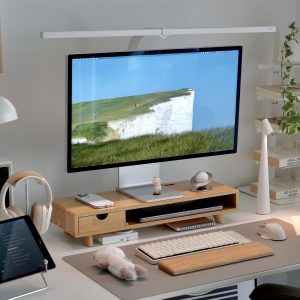
This entire sequence takes 60 seconds and can be done without leaving your desk. Pair it with a quick ergonomic check—ensure your monitor is at eye level to prevent neck strain. Slowvana’s bamboo monitor stand is designed to raise your display to the perfect height, reducing the need for constant micro-adjustments that add to cognitive load.
Technique 3: The 60-Second Eye Reset (Reduce Digital Fatigue)
Screen stress is real. Digital eye strain—caused by prolonged near-focus, blue light exposure, and reduced blink rate—triggers headaches, dry eyes, and mental fatigue. This technique is backed by the 20-20-20 rule recommended by the American Optometric Association:
- 0–20 seconds: Look away from your screen at an object 20 feet away. Focus on it softly.
- 20–40 seconds: Close your eyes. Place your palms over them without applying pressure. Let the darkness reset your visual system.
- 40–60 seconds: Open your eyes. Slowly move your gaze from left to right, then up and down, without moving your head. Blink fully and slowly.
This 60-second reset reduces accommodative stress in your eye muscles and gives your brain a micro-break from constant visual input. A cluttered desk can add to visual stress—keeping your workspace organized with a clean desk organizer reduces cognitive load and helps you stay calm.
Technique 4: The 60-Second Grounding Exercise
When your mind is racing, grounding techniques pull you back to the present moment. This one is adapted from cognitive behavioral therapy (CBT) and takes exactly 60 seconds:
- 0–15 seconds: Name 5 things you can see in your immediate environment. Say them silently or aloud.
- 15–30 seconds: Name 4 things you can feel—the texture of your desk, the fabric of your chair, the air on your skin.
- 30–45 seconds: Name 3 things you can hear—the hum of your computer, distant traffic, your own breath.
- 45–60 seconds: Name 2 things you can smell or 1 thing you can taste.
This technique activates your prefrontal cortex and shifts activity away from the amygdala, the brain’s fear center. It’s especially effective for racing thoughts before a presentation or after a stressful call. Pair it with a physical anchor—like touching the smooth bamboo surface of Slowvana’s desk organizer—to deepen the sensory connection.
Technique 5: The 60-Second Ergonomic Reset
Most desk workers set up their workstation once and never adjust it. But over hours, your body shifts—you slouch, your wrists drift, your monitor tilts. An ergonomic reset takes 60 seconds and prevents the physical stress that feeds mental stress:
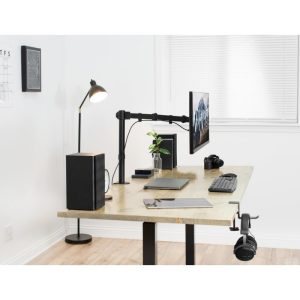
- 0–20 seconds: Check your monitor height. Your eyes should align with the top third of the screen. If you’re looking down, raise your monitor with a stand. Slowvana’s bamboo monitor stand lifts your screen to the correct height, reducing neck strain by up to 30% according to ergonomic studies.
- 20–40 seconds: Check your wrists. They should be straight, not bent up or down, when typing. If your wrists are extended, consider a gel wrist rest to maintain a neutral position.
- 40–60 seconds: Check your feet. They should be flat on the floor, knees at 90 degrees. If your feet dangle, use a footrest. This stabilizes your pelvis and reduces lower back tension.
This reset is a physical “save point”—a moment to realign your body with your workspace. Slowvana’s entire product line is designed to support this kind of quick, intuitive adjustment, so you spend less time fighting your setup and more time in flow.
Build a Micro-Recovery Habit That Sticks
The most effective stress relief technique is the one you actually do. Here’s how to make these 60-second resets a lasting habit:
- Trigger stacking: Attach each technique to an existing habit. For example, do the breathing reset every time you open a new email tab. Do the stretch sequence after every phone call.
- Visual cues: Place a sticky note on your monitor or set a gentle phone reminder. Slowvana’s bamboo desk organizer can hold a small note or a calming object as a physical trigger.
- Start small: Commit to just one technique per day for the first week. One 60-second reset is infinitely better than zero.
- Track your recovery: Note how you feel before and after each reset. Awareness builds momentum.
Remember: recovery is not a luxury—it’s a productivity tool. When you reset your nervous system in 60 seconds, you return to work with clearer thinking, steadier emotions, and less physical pain. That’s the heart of the Slowvana recovery lifestyle: small, intentional actions that compound into lasting well-being.
Frequently Asked Questions
Can 60 seconds really reduce stress?
Yes. Research shows that brief, focused interventions like diaphragmatic breathing and muscle relaxation can lower cortisol levels and heart rate within minutes. While 60 seconds won’t solve chronic stress alone, it provides an immediate reset that prevents stress from compounding throughout the day.
What is the best stress relief technique for desk workers?
The best technique is the one you’ll do consistently. For most desk workers, a combination of slow breathing and a quick ergonomic reset offers the fastest relief. The 4-4-6 breathing pattern (inhale 4, hold 4, exhale 6) is particularly effective because it directly activates the parasympathetic nervous system.
How often should I take stress relief breaks at work?
Aim for one 60-second reset every 45–60 minutes. This aligns with your body’s natural ultradian rhythm—the 90-minute cycles of high and low focus. Taking a micro-break at the end of each cycle prevents mental fatigue and physical tension from accumulating.
Can ergonomic products help with stress?
Absolutely. Ergonomic products reduce physical stressors that amplify mental stress. A monitor stand that eliminates neck strain, a wrist rest that prevents wrist pain, and an organized desk that reduces visual clutter all lower your cognitive load. Slowvana’s product line is designed to support these micro-recoveries throughout the workday.
What should I do if I feel stressed but can’t leave my desk?
You don’t need to leave your desk. Use the grounding exercise (5-4-3-2-1 technique) or the 60-second breathing reset. Both can be done discreetly while seated. Slowvana recommends keeping a small physical anchor—like a smooth bamboo object—on your desk to trigger a calming sensory response.
🪑 Fix Your Desk Setup in 5 Minutes
Download the free Ergonomic Setup Checklist — 15 steps to reduce pain and work comfortably.
Get Free Checklist →