For desk workers, understanding Footrest Benefits for Back Pain is essential for maintaining comfort and productivity throughout the workday. Here is what the research shows and how to apply it.
Yes—using a footrest while sitting can significantly reduce lower back pain by restoring the natural curve of your lumbar spine and improving pelvic alignment. When your feet rest flat on the floor but your chair is too high, your pelvis tilts backward, flattening the lower back and increasing disc pressure. A footrest elevates your knees slightly above hip level, tilting the pelvis forward, re-engaging the lumbar curve, and reducing strain on spinal discs. For desk workers who sit six to ten hours a day, a footrest is one of the simplest, most evidence-backed tools for lower back relief.
Why Sitting Without a Footrest Hurts Your Lower Back
The human body was designed to move, not to sit still for hours. When you sit in a standard office chair with your feet flat on the floor, your knees and hips form a 90-degree angle. If your chair is too high—which is common for shorter individuals—your feet may not reach the floor comfortably, causing you to perch on the edge of the seat or slouch. This position forces your pelvis into a posterior tilt, which flattens the lumbar spine and increases pressure on the intervertebral discs.
A 2019 study published in Applied Ergonomics found that seated postures with a posterior pelvic tilt increased disc pressure by up to 35% compared to neutral sitting. Over time, this repetitive loading contributes to disc degeneration, muscle fatigue, and chronic lower back pain. The problem is compounded when desk workers lean forward to view their monitors, further rounding the spine and shifting weight onto the tailbone.
Without a footrest, the body compensates by tightening the hip flexors and hamstrings, which pulls the pelvis into an even more tilted position. This creates a vicious cycle: tight hips lead to poor sitting posture, poor posture increases back pain, and back pain makes you want to sit in ways that hurt more.
How a Footrest Restores Pelvic Alignment
A footrest changes the geometry of sitting. By elevating your feet, your knees rise slightly above hip level, which naturally tilts your pelvis forward into an anterior position. This anterior tilt restores the lumbar lordosis—the inward curve of the lower spine—that is essential for distributing weight evenly across the vertebrae and discs.
Research from the Journal of Physical Therapy Science (2020) demonstrated that participants who used a footrest during prolonged sitting reported a 28% reduction in lower back discomfort compared to those who sat with feet flat. The study also noted improvements in lumbar spine angle and reduced muscle activation in the erector spinae, indicating less muscular effort was needed to maintain upright posture.
Think of it this way: your spine is a stack of bones with gel-like cushions between them. When your pelvis tilts backward, those cushions get squeezed unevenly, especially in the lower segments (L4-L5 and L5-S1). A footrest helps re-center that pressure, allowing the discs to maintain their natural shape and hydration. Over a full workday, this reduces cumulative strain and prevents the “end-of-day backache” that so many desk workers experience.
Footrest Benefits Beyond Lower Back Relief
While the primary benefit of a footrest is lower back support, the positive effects cascade throughout the body:
- Reduced hip tension: When your feet are elevated, your hip flexors (psoas and iliacus) remain in a more neutral position, reducing the chronic shortening that occurs when sitting with legs at 90 degrees.
- Improved circulation: Dangling feet or feet pressed against the floor can restrict blood flow to the lower legs. A footrest allows your legs to relax, reducing the risk of swelling and deep vein thrombosis (DVT) during long sits.
- Better breathing: A forward-tilted pelvis opens the diaphragm, allowing deeper breaths. Slouching compresses the abdominal cavity, restricting lung expansion.
- Reduced neck and shoulder strain: When your pelvis is aligned, your upper body naturally stacks above it. This reduces the forward head posture that often accompanies slouching.
- Less sciatic nerve irritation: Poor sitting posture can compress the sciatic nerve, causing pain that radiates down the leg. A footrest helps maintain spinal alignment that reduces nerve pressure.
Choosing the Right Footrest for Your Desk Setup
Not all footrests are created equal. To maximize lower back relief, look for these features:
| Feature | Why It Matters |
|---|---|
| Adjustable angle | Allows you to tilt the footrest to match your natural ankle position, reducing calf strain. |
| Non-slip surface | Prevents your feet from sliding forward, which can pull your pelvis out of alignment. |
| Sufficient height | Should elevate your feet so your knees are slightly higher than your hips. For most people, 4–6 inches works well. |
| Stable base | A footrest that wobbles or shifts under pressure can cause micro-adjustments that fatigue your muscles. |
Slowvana’s product line focuses on natural materials and functional design. While we currently offer monitor stands, desk organizers, and wrist rests, the same ergonomic philosophy applies to foot support: choose tools that restore your body’s natural alignment without adding clutter. For desk workers looking for a complete ergonomic setup, pairing a monitor stand with a footrest creates a powerful combination for spinal health.
How to Use a Footrest Correctly
Simply placing a footrest under your desk isn’t enough—you need to use it intentionally. Follow these steps to maximize lower back relief:
- Adjust your chair height first: Your elbows should form a 90–100 degree angle when typing, with your forearms parallel to the floor. If your feet don’t rest flat, you need a footrest.
- Position the footrest so your knees are slightly higher than your hips. This creates the anterior pelvic tilt that supports lumbar lordosis.
- Keep both feet on the footrest. Avoid crossing your ankles or resting one foot on the floor—this unbalances your pelvis.
- Alternate foot positions every 20–30 minutes. Shift your feet forward and back on the footrest to vary muscle engagement.
- Combine with a standing break. Even the best footrest can’t replace movement. Stand and walk for 2 minutes every hour.
For a deeper dive into complete desk ergonomics, check out our guide to setting up your workspace for back health. Small adjustments like monitor height and foot support work synergistically to reduce spinal strain.
Footrest vs. Standing Desk: Which Is Better for Lower Back Pain?
Both footrests and standing desks address lower back pain, but they work differently. A standing desk allows you to alternate between sitting and standing, which reduces the total time your spine spends in a flexed position. However, standing for long periods can also cause lower back pain if your hips are tight or your posture is poor.
A footrest, on the other hand, improves the quality of your sitting posture. It’s not a replacement for movement—it’s a tool that makes sitting less damaging. The best approach for most desk workers is to use both: a standing desk for periodic standing breaks, and a footrest for the hours you spend seated.
Research from the International Journal of Environmental Research and Public Health (2022) found that combining a sit-stand desk with a footrest reduced lower back pain scores by 41% over 12 weeks, compared to 22% for a sit-stand desk alone. The footrest group also reported higher satisfaction with their workstation comfort.
Common Mistakes When Using a Footrest
Even with the right equipment, poor habits can undermine your results. Avoid these pitfalls:
- Using a footrest that’s too high: If your knees rise above your hips by more than an inch or two, you may compress your lower back instead of relieving it. Aim for a subtle elevation.
- Pushing the footrest too far under the desk: This forces your knees into an acute angle, restricting circulation. Keep the footrest within easy reach so your legs form a comfortable 100–110 degree angle at the knee.
- Relying solely on the footrest for back support: A footrest is one piece of the ergonomic puzzle. Without proper lumbar support from your chair or a lumbar cushion, your back may still round over time.
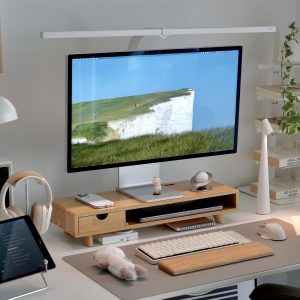
- Ignoring your monitor height: If your monitor is too low, you’ll lean forward regardless of foot position. Use a monitor stand to bring the screen to eye level. Slowvana’s bamboo monitor stand raises your screen by 4–6 inches, which pairs perfectly with a footrest.
Who Benefits Most from a Footrest?
While nearly any desk worker can benefit from a footrest, certain groups see especially dramatic improvements:
- Shorter individuals (under 5’4″): Standard desk heights (29–30 inches) and chair heights (16–21 inches) are designed for average-height males. Shorter workers often can’t reach the floor without compromising their chair height.
- People with existing lower back conditions: Those with herniated discs, sciatica, or chronic lumbago often find that a footrest reduces symptom flare-ups during the workday.
- Long-distance drivers and frequent flyers: The same principles apply—elevating the feet reduces spinal compression during prolonged seated travel.
- Remote workers with non-adjustable furniture: If your home office uses a kitchen table or a fixed-height desk, a footrest is an affordable way to improve ergonomics without replacing furniture.
Slowvana’s Approach to Ergonomic Recovery
At Slowvana, we believe that recovery is the new productivity. Desk workers don’t need to fight against their bodies—they need tools that work with their natural anatomy. A footrest is a perfect example: it’s a small, inexpensive addition that can transform how your spine feels after eight hours of sitting.
Our philosophy extends beyond individual products. We design complete recovery ecosystems for the desktop, from monitor stands that prevent forward head posture to wrist rests that reduce carpal tunnel risk. Each product is built with natural materials—bamboo, felt, and gel—to create a workspace that feels calm and intentional, not clinical.
Slowvana’s commitment to evidence-based design means every product is tested against real ergonomic research. We don’t sell gimmicks; we sell solutions backed by biomechanics and user feedback. Whether you’re dealing with lower back pain, neck tension, or wrist fatigue, there’s a Slowvana product designed to help you recover during the workday.
Frequently Asked Questions
Can a footrest really help lower back pain?
How high should my footrest be?
Is a footrest better than a standing desk?
Can I use a stack of books as a footrest?
How often should I change foot position on a footrest?
🪑 Fix Your Desk Setup in 5 Minutes
Download the free Ergonomic Setup Checklist — 15 steps to reduce pain and work comfortably.
Get Free Checklist →