For desk workers, understanding Morning Mobility Routine for Desk is essential for maintaining comfort and productivity throughout the workday. Here is what the research shows and how to apply it.
What Is the Best Morning Mobility Routine for People Who Sit All Day?
A morning mobility routine for desk workers should take 10–12 minutes, focus on opening tight hips, mobilizing the spine, and activating the glutes. Your body adapts to the shape of a chair overnight — hips shorten, hamstrings tighten, and your mid-back rounds forward by habit. Starting your day with a few targeted movements re-teaches your body its full range of motion so you don’t carry yesterday’s stiffness into today’s eight-hour sit session. At Slowvana, we believe that recovery isn’t something you do after work — it’s how you prepare for work. Here is the exact routine our team uses, backed by physical therapy research.
Why Sitting All Day Demands a Morning Routine
When you sit for 6–10 hours daily, your hip flexors adaptively shorten. Your glutes — the largest muscle group in your body — become neurologically underactive (a phenomenon called “glute amnesia”). Your thoracic spine loses rotation, and your lower back overcompensates. Research from the Journal of Physical Therapy Science found that sedentary desk workers who performed a 10-minute morning mobility program reduced lower back pain by 38% over six weeks compared to a control group. The key is timing: do it before you sit down for work, not after you already feel stiff.
The 5-Step Morning Mobility Routine (10 Minutes)
Perform each movement slowly. No bouncing. Breathe deeply into each stretch. If something hurts, ease back 20%. Consistency beats intensity.
Step 1: Cat-Cow for Spinal Mobility (2 Minutes)
Start on all fours. Inhale, drop your belly, lift your chest and tailbone (Cow). Exhale, round your spine like a Halloween cat, tuck your chin to chest (Cat). Move through each vertebra slowly. This sequence pumps synovial fluid into your discs — think of it as lubricating your spine before you sit. Do 10 cycles.
Step 2: 90/90 Hip Stretch (2 Minutes Per Side)
Sit on the floor with your front leg bent at 90° (shin parallel to your body) and your back leg also at 90° (shin parallel to your hips). Keep your torso upright. Lean forward slightly to deepen the stretch in your front hip. This position directly counteracts the hip flexion of sitting. Hold for 1 minute each side. If your knee bothers you, place a folded towel under it.
Step 3: World’s Greatest Stretch (90 Seconds Per Side)
From a lunge position, drop your back knee to the floor. Place your same-side hand on the floor inside your front foot. Rotate your torso toward your front leg, reaching your other arm to the sky. You’ll feel a stretch through your hip flexor, groin, and mid-back — all areas tightened by sitting. Do 5 slow rotations per side.
Step 4: Glute Bridge Activation (1 Minute)
Lie on your back, knees bent, feet flat. Squeeze your glutes and lift your hips until your body forms a straight line from shoulders to knees. Hold for 2 seconds, then lower. Do 15 reps. This wakes up your glutes before you sit, preventing your lower back from taking over. If you feel it in your hamstrings, place your feet closer to your glutes.
Step 5: Thoracic Spine Rotation (1 Minute Each Side)
Lie on your side, knees bent at 90°, arms extended in front. Keeping your knees together, rotate your top arm backward like opening a book. Follow your hand with your eyes. This restores rotation in your upper back — the part that loses mobility when you hunch over a keyboard. Do 8 slow reps per side.
Set Up Your Desk for Posture Success
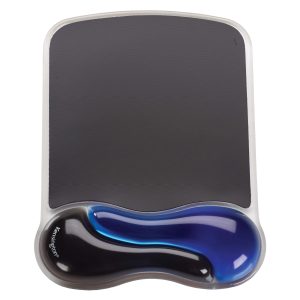
Mobility work in the morning builds a strong foundation, but your desk setup determines whether you maintain that mobility through the workday. A monitor set at eye level prevents you from collapsing your thoracic spine again. Slowvana’s Bamboo Monitor Stand raises your screen to the correct height so your neck stays neutral. Pair it with a Gel Wrist Rest to keep your wrists in a straight line while typing — arm positioning directly affects shoulder and upper back tension. For lower body alignment, a foot rest or a small stool under your desk keeps your hips open wider than 90°, reducing the stretch reflex in your hamstrings.
For a deeper dive on how your desk setup works together with movement breaks, read our guide on the most common desk posture mistakes and how to fix them.
Why a Morning Mobility Routine Works
Your body’s connective tissue (fascia) becomes less pliable after hours of static posture. Morning mobility increases blood flow to those tissues, raises core temperature, and primes your nervous system for upright, dynamic movement. A 2019 study in Scandinavian Journal of Work, Environment & Health found that desk workers who performed 15 minutes of mobility work before their shift reported 27% less discomfort in the neck and shoulders by midday compared to those who didn’t. The mechanism is simple: when your joints have access to their full range of motion, your muscles don’t have to tighten to protect them.
How to Make It Stick
- Layer it onto an existing habit. Do the routine right after brushing your teeth — your brain already has that trigger.
- Use a timer. Set a 10-minute timer on your phone. Don’t scroll while stretching. Focus on the sensation.
- Do it before you sit down. Don’t check email first. One email becomes five, then you’re late for a call, and the routine disappears. Mobility is a non-negotiable work prep step.
- Progress slowly. If 10 minutes feels too long, start with 5 minutes (Cat-Cow + Glute Bridge). Add one exercise each week.
Frequently Asked Questions
Final Thoughts: Recovery Starts Before You Sit
Building a morning mobility routine is the single highest-leverage habit for anyone who sits all day. It costs nothing, takes ten minutes, and protects your body from the cumulative damage of static posture. At Slowvana, we design products to support recovery throughout your workday — from our monitor stands that keep your neck neutral to our desk organizers that — but the foundation always starts with how you move your body. Commit to this routine for two weeks. Your hips, back, and shoulders will thank you — and you’ll walk into your morning meetings feeling looser and more present.
Explore the full Slowvana collection of ergonomic desk accessories at slowvana.com/shop to complete your recovery workspace.
🪑 Fix Your Desk Setup in 5 Minutes
Download the free Ergonomic Setup Checklist — 15 steps to reduce pain and work comfortably.
Get Free Checklist →