This comprehensive guide covers everything desk workers need to know about Circadian Rhythm and Sleep Quality: Reset Your Body Clock for Better Rest – from science-backed fundamentals to practical implementation. Start with the basics and build your perfect setup step by step.
Your Desk Job Is Hijacking Your Sleep—Here’s How to Take It Back
You close your laptop at 10 p.m., crawl into bed, and lie there. Wide awake. Your brain is still running through emails, your shoulders feel tight, and your eyes burn from another 10-hour screen session. Sound familiar?
You’re not alone. A 2022 study in Chronobiology International found that remote workers report a 40% higher rate of sleep disturbances compared to in-office employees. The culprit? A disrupted circadian rhythm—your body’s internal 24-hour clock that tells you when to wake, eat, and sleep.
For desk workers, the modern workday is a perfect storm: prolonged sitting, constant screen exposure, and blurred boundaries between work and rest. The good news? You can reset your circadian rhythm without quitting your job or moving to a cabin in the woods. In this guide, we’ll explore the science of your body clock, why desk work throws it off, and actionable steps—including how your workstation setup plays a role—to reclaim deep, restorative sleep.
What Is Circadian Rhythm—and Why Should a Desk Worker Care?
Your circadian rhythm is more than just a fancy term for your sleep-wake cycle. It’s a master clock in your brain—specifically the suprachiasmatic nucleus (SCN)—that orchestrates nearly every biological process: hormone release, body temperature, metabolism, and cognitive performance.
Think of it as your body’s conductor, keeping all your systems in harmony. The most powerful cue it responds to? Light. Morning sunlight tells your SCN to suppress melatonin (the sleep hormone) and release cortisol (the alertness hormone). Evening darkness does the opposite, ramping up melatonin to prepare you for sleep.
But here’s the problem for desk workers: we spend 90% of our waking hours indoors under artificial lighting—often staring at screens emitting high levels of blue light—and then wonder why we can’t fall asleep. A 2019 study in Physiology & Behavior showed that just two hours of screen time before bed can delay melatonin production by up to 90 minutes.
When your circadian rhythm is out of sync, you don’t just sleep poorly. You experience:
- Brain fog and reduced productivity during work hours
- Increased stress and mood swings
- Higher risk of metabolic issues and weight gain
- Weakened immune function
How Desk Work Specifically Disrupts Your Body Clock
It’s not just screen time. The desk worker lifestyle attacks your circadian rhythm from multiple angles:
1. Morning Light Deprivation
Most desk workers wake up, grab their phone, and walk straight to their home office—often before the sun is fully up or without stepping outside. Morning sunlight is the strongest signal for your SCN to set your internal clock for the day. Without it, your body never gets the memo that it’s daytime, leaving you groggy and delaying your natural sleep onset.
2. Afternoon Energy Crashes
Your circadian rhythm naturally dips in the early afternoon (around 1–3 p.m.), creating a wave of sleepiness. Instead of honoring this dip with a brief rest or walk, most desk workers reach for coffee and power through. This disrupts your natural energy curve and can interfere with nighttime sleep.
3. Evening Blue Light Overload
Working late? Scrolling your phone after dinner? The blue light from screens tricks your brain into thinking it’s still daytime, suppressing melatonin and delaying your sleep onset. A 2020 meta-analysis in Sleep Medicine Reviews confirmed that evening screen exposure significantly reduces both sleep quality and total sleep time.
4. Prolonged Sitting and Poor Posture
Here’s a connection most people miss: physical discomfort during the day directly impacts sleep quality. When you sit for hours with poor posture—slouching, craning your neck, or resting your wrists on a hard desk—you create muscle tension and joint strain that persists into the evening. That tension signals your nervous system to stay in a state of low-grade stress, making it harder to relax into sleep.
“The body keeps the score of your workday posture,” says Dr. Emily Carter, a sleep medicine specialist at Stanford. “If your spine is misaligned for eight hours, your parasympathetic nervous system—the ‘rest and digest’ system—struggles to activate at night.”
7 Actionable Steps to Reset Your Circadian Rhythm as a Desk Worker
You don’t need a complete lifestyle overhaul. Start with these evidence-backed strategies:
Step 1: Get 10–20 Minutes of Morning Sunlight (Within 30 Minutes of Waking)
This is the single most effective circadian reset. Morning sunlight has a high intensity of blue light that signals your SCN to start the day. Even on cloudy days, outdoor light is 10–100 times brighter than indoor office lighting. Walk around the block, have your coffee on the balcony, or simply stand by an open window.
Step 2: Create an “Evening Light Curfew”
Two hours before bed, dim your lights and switch to warm, amber-toned lighting. Use blue-light-blocking glasses if you must work late. Most importantly, stop scrolling screens at least 30 minutes before sleep. Instead, read a physical book, journal, or do gentle stretching.
Step 3: Honor Your Afternoon Dip with a Micro-Break
Instead of fighting the 2 p.m. slump with caffeine, take a 10-minute walk outside or do a quick stretching sequence. This aligns with your natural circadian dip and can boost afternoon alertness without disrupting nighttime sleep.
Step 4: Use Your Workstation to Support Your Body Clock
Your physical setup can either help or hinder your circadian rhythm. Here’s how to make it work for you:
- Monitor position: Place your screen at eye level (using a monitor stand) to reduce neck strain and forward head posture. When your neck is relaxed, your nervous system stays calmer throughout the day.
- Wrist support: A gel wrist rest keeps your wrists in a neutral position, reducing tension that travels up to your shoulders and neck. Less tension = easier transition to sleep.
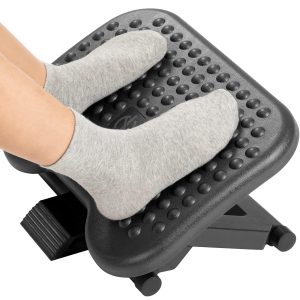
- Foot support: A foot rest improves circulation and pelvic alignment. When your legs aren’t dangling or straining, your body can fully relax in the evening.
- Lumbar support: A lumbar cushion maintains your spine’s natural curve, preventing the slouching that creates muscle tension and stress signals.
Think of your workstation as a sleep-preparation zone. The more comfortable and aligned you are during the day, the less physical baggage you carry to bed.
Step 5: Keep a Consistent Sleep-Wake Schedule (Even on Weekends)
Your circadian rhythm thrives on consistency. Going to bed and waking up at the same time every day—within a 30-minute window—reinforces your body clock. A 2021 study in Sleep found that people with irregular sleep schedules had a 27% higher risk of poor sleep quality, regardless of total sleep time.
Step 6: Time Your Meals and Caffeine
Your digestive system also follows a circadian rhythm. Try to finish your last meal at least 2–3 hours before bed. Caffeine has a half-life of 5–6 hours, so cut off coffee by 2 p.m. at the latest.
Step 7: Wind Down with a Body Scan or Gentle Stretch
Before bed, spend 5–10 minutes doing a seated or lying-down body scan. Notice where you’re holding tension—often in the shoulders, neck, and lower back from a day of sitting. Gentle stretching or foam rolling can release this physical stress and signal your nervous system that it’s safe to sleep.
The Ergonomics-Sleep Connection: Why Your Chair Matters at Night
We’ve touched on this, but it’s worth emphasizing: your daytime posture directly influences your nighttime recovery. When you sit for hours with poor alignment, your muscles and fascia develop micro-tension that doesn’t just disappear when you stand up. This tension accumulates, keeping your sympathetic nervous system (fight-or-flight) activated.
Think of it this way: your body doesn’t know the difference between sitting in a stressful meeting and running from a predator. The physical tension is the same. By optimizing your workstation ergonomics—with proper monitor height, wrist support, foot support, and lumbar support—you reduce the physical stress signals that interfere with sleep.
Investing in your workspace is investing in your sleep. It’s not about buying fancy gear; it’s about giving your body the support it needs to stay relaxed all day so it can fully recover all night.
Your Circadian Rhythm Reset Checklist
| Time of Day | Action | Why It Works |
|---|---|---|
| Morning (0–30 min after waking) | 10–20 minutes of outdoor sunlight | Sets your SCN for the day |
| Mid-morning | Take a 5-min walking break | Reinforces circadian timing |
| Afternoon (1–3 p.m.) | Take a 10-min walk or stretch | Honors natural energy dip |
| Evening (2 hours before bed) | Dim lights, use warm lighting | Prepares melatonin release |
| 30 min before bed | No screens, gentle stretching | Reduces blue light + tension |
| Bedtime | Consistent time ±30 min | Reinforces body clock |
When to Seek Professional Help
If you’ve tried these strategies for 4–6 weeks and still struggle with sleep, consider consulting a sleep specialist. Conditions like delayed sleep-wake phase disorder, insomnia, or sleep apnea can mimic circadian disruption and require targeted treatment.
Your Takeaway: Small Changes, Big Sleep Gains
Your circadian rhythm isn’t broken—it’s just out of alignment with your desk worker lifestyle. By making small, intentional shifts in your daily routine (morning light, evening wind-down, and a supportive workstation), you can reset your body clock and unlock deeper, more restorative sleep.
Start with one change tomorrow morning: step outside for 10 minutes of sunlight before you open your laptop. Your body—and your sleep—will thank you.
🪑 Fix Your Desk Setup in 5 Minutes
Download the free Ergonomic Setup Checklist — 15 steps to reduce pain and work comfortably.
Get Free Checklist →