For desk workers, understanding The Perfect Desk Setup for Stress Reduction (Not Just Posture) is essential for maintaining comfort and productivity throughout the workday. Here is what the research shows and how to apply it.
Your Desk Might Be Stressing You Out—Here’s How to Fix It
You’ve optimized your chair height. You’ve aligned your screen at eye level. You’ve even invested in a lumbar cushion. And yet, by 3 PM, your shoulders are up by your ears, your jaw is clenched, and your mind feels like a browser with 47 tabs open.
If that sounds familiar, you’re not alone—and it’s not a failure of willpower. The problem is that most ergonomic advice focuses exclusively on physical alignment, ignoring a critical factor: your nervous system.
Your desk setup isn’t just a tool for posture—it’s a stress ecosystem. Every element, from the height of your monitor to the texture of your wrist rest, sends signals to your brain. When those signals say “danger,” your body responds with cortisol, tension, and mental fog. When they say “safety,” you breathe easier, focus deeper, and work with less effort.
In this guide, we’ll show you how to design a desk setup for stress reduction—not just posture. Backed by research and designed for real life, these changes will help you feel calmer, clearer, and more in control, starting today.
Why Stress at Your Desk Is a Design Problem, Not a You Problem
Let’s start with a hard truth: Your workspace is probably working against your nervous system.
According to the American Institute of Stress, 83% of US workers suffer from work-related stress, and 54% say it impacts their home life. But here’s what most people miss: a significant portion of that stress is environmental, not just psychological.
When you sit at a desk that doesn’t support your body’s natural needs, your brain interprets that discomfort as a threat. It’s not a conscious thought—it’s a primal response. Your muscles tense to “protect” you. Your breathing becomes shallow. Your heart rate variability drops. Over hours and days, this low-grade stress response accumulates into chronic tension, fatigue, and even anxiety.
A 2021 study in the Journal of Environmental Psychology found that people who rated their workspace as “poorly designed” reported 30% higher cortisol levels than those in “optimized” spaces. The kicker? Most of those participants couldn’t articulate why their space felt wrong—they just felt stressed.
The good news: when you intentionally design your desk for stress reduction, you can reverse this cycle. Here’s how.
Section 1: The Foundation—Lower Your Visual and Physical Load
Before we talk about gadgets or aesthetics, we need to address the two biggest stress drivers at any desk: visual strain and physical tension.
1.1 Your Screen Height Is a Stress Lever
When your monitor is too low, you tilt your head forward. That forward head posture compresses your cervical spine, reduces blood flow to your brain, and—critically—activates your sternocleidomastoid and upper trapezius muscles. These are the same muscles that tighten when you’re anxious.
In other words, a low screen doesn’t just hurt your neck—it tricks your brain into feeling stressed.
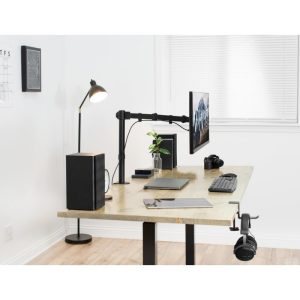
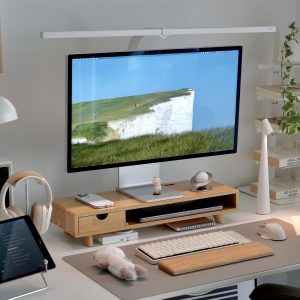
The fix: Raise your monitor so the top third of the screen is at eye level. This keeps your head balanced over your spine, which signals safety to your nervous system. If your desk doesn’t adjust, a monitor stand can do the job without breaking your flow.
Pro tip: If you use a laptop, don’t just tilt the screen back—raise the entire device with a stand, and use a separate keyboard and mouse. Your neck will thank you by 5 PM.
1.2 Your Wrist Position Controls Your Breathing
This might sound strange, but bear with me. When your wrists are bent upward (extension) or angled to the side (ulnar deviation), your forearm muscles contract. That tension travels up your arm, into your shoulders, and tightens your chest. A tight chest restricts your diaphragm, making your breathing shallow and rapid.
Shallow breathing is a direct signal to your brain that you’re in danger. It triggers the sympathetic nervous system—your fight-or-flight response.
The fix: Keep your wrists in a neutral position—straight, not bent up or down. Use a wrist rest to support your palms without lifting your wrists. Your keyboard should be flat or slightly negative-tilted (tilted away from you) to keep your wrists straight.
When your wrists are neutral, your shoulders drop, your chest opens, and your breath deepens. You’re not just reducing strain—you’re telling your body it’s safe to relax.
Section 2: Grounding Your Body—The Role of Your Feet and Seat
Most ergonomic advice focuses on your upper body (neck, shoulders, wrists). But your lower body is the foundation of your nervous system’s sense of stability.
2.1 Your Feet Are Your First Anchor
When your feet don’t rest flat on the floor or a stable surface, your hips tilt, your pelvis rotates, and your lower back arches or rounds. That instability forces your core muscles to work overtime—creating a constant low-level tension that your brain reads as “unsteady.”
An unsteady body is a stressed body.
The fix: If your feet don’t reach the floor when your chair is at the right height, use a foot rest. This isn’t just about comfort—it’s about creating a stable base that signals safety to your nervous system. Your feet should be flat, knees at a 90-degree angle, and hips slightly higher than your knees.
When you’re grounded, your brain allocates less energy to “holding you up” and more to the work you actually want to do.
2.2 Your Lower Back and Belly Breathing
Your lower back is intimately connected to your diaphragm. When you slump or lean back without support, your diaphragm can’t descend fully. That means every breath is shallower than it should be.
A 2019 study in Frontiers in Psychology found that participants who used lumbar support while sitting showed significantly higher heart rate variability (HRV)—a marker of parasympathetic (rest-and-digest) activation—compared to those who sat without support.
The fix: A lumbar support cushion that fills the natural curve of your lower back will help you sit upright without effort. When your spine is in its natural S-curve, your rib cage opens, your diaphragm moves freely, and your breathing deepens. That deep breathing is the fastest way to lower cortisol in real time.
Try this: Place the lumbar support so it hits the small of your back, not your mid-back. You should feel an immediate sense of “opening” in your chest.
Section 3: Calming Your Senses—Light, Sound, and Scent
Posture and support only go so far if your environment is assaulting your senses. Here’s how to design a desk setup that actively reduces sensory stress.
3.1 Lighting: The Master Stress Switch
Harsh overhead fluorescent lighting is one of the most underrated stressors in modern offices. It flickers at frequencies invisible to the eye but detectable by the brain, increasing cortisol and eye fatigue.
The fix: Use warm, indirect task lighting instead of overhead lights. Position a lamp so it illuminates your work surface without casting glare on your screen. If you can’t control overhead lights, consider a dimmable LED desk lamp with color temperature adjustment (2700K–3000K is ideal for calm).
Even better: position your desk perpendicular to a window. Natural light exposure, especially in the morning, helps regulate your circadian rhythm and improves mood.
3.2 Sound and Silence
Open-office noise or loud household sounds trigger the startle reflex, releasing cortisol even if you don’t consciously notice. A 2020 study in Noise & Health found that intermittent noise (conversations, doors, traffic) increased stress more than constant noise.
The fix: Use noise-canceling headphones or a white noise machine. Alternatively, play background sounds at 50–60 dB (like rain or fan noise) to mask sudden sounds. If you need silence, foam earplugs can work wonders.
3.3 Scent and the Limbic System
Your olfactory system is directly wired to your amygdala and hippocampus—the brain’s emotion and memory centers. Certain scents can lower cortisol in minutes.
The fix: A small diffuser with lavender, bergamot, or frankincense essential oil near your desk can promote calm. Avoid synthetic air fresheners, which can contain VOCs that trigger headaches or irritation.
Quick note: If you’re sensitive to scents, skip this step. The goal is reduction, not addition.
Section 4: Micro-Movements as Stress Release
Even the best desk setup can’t eliminate the need to move. But here’s the key: you don’t need a 30-minute yoga session. You need micro-movements—small, intentional shifts that reset your nervous system.
4.1 The 20-20-20 Rule for Your Eyes
Every 20 minutes, look at something 20 feet away for 20 seconds. This relaxes your ciliary muscles (which control focus) and reduces eye strain. But it also gives your brain a micro-break from the cognitive load of staring at a screen.
4.2 Shoulder Rolls and Neck Nods
Set a timer for every 30 minutes. Roll your shoulders back and down 5 times. Then, slowly nod your head forward and back 3 times. These movements break the “freeze” response that happens when you’re hyper-focused.
4.3 Stand and Stretch for 60 Seconds
Once an hour, stand up. Reach your arms overhead. Take three deep breaths. That’s it. This resets your posture, reoxygenates your blood, and signals to your body that the “threat” has passed.
Research note: A 2022 study in Workplace Health & Safety found that hourly 60-second standing breaks reduced self-reported stress by 28% and improved focus by 18%.
Conclusion: Your Desk as a Sanctuary, Not a Stressor
You don’t need a complete office renovation to reduce stress at your desk. You need a few intentional changes that work with your body and brain, not against them.
Start with one thing: raise your screen, support your wrists, or ground your feet. Notice how your body responds. Then add another piece. Over time, your desk will transform from a source of tension into a space of focus and calm.
Remember: the perfect desk setup for stress reduction isn’t about perfection. It’s about creating an environment that constantly whispers to your nervous system, “You are safe. You can rest. You can focus.”
And that whisper is louder than any ergonomic checklist.
“Your workspace is not just where you work—it’s where your body lives for eight hours a day. Design it for peace, and your work will follow.”
🪑 Fix Your Desk Setup in 5 Minutes
Download the free Ergonomic Setup Checklist — 15 steps to reduce pain and work comfortably.
Get Free Checklist →