The link between Foot Rest Benefits and Why Your Chair Height Matters More Than You Think directly affects desk worker health. Understanding this relationship helps you address the root cause rather than just treating symptoms.
Your Feet Are Not Meant to Dangle
Imagine sitting at your desk for eight hours. Your hips are at 90 degrees, your back is straight, and your monitor is at eye level. But your feet? They’re dangling like a child on a too-tall chair. Sound familiar?
If you’re a desk worker or remote professional, you’ve probably focused on your chair, screen height, and keyboard placement. But there’s a silent culprit undermining your posture: chair height — and the simple solution of a foot rest.
In this article, we’ll explore the science-backed foot rest benefits, why chair height is more critical than you think, and how a small change can transform your workday comfort and long-term health.
Why Chair Height Matters for Desk Workers
Chair height isn’t just about comfort — it’s about biomechanics. When your chair is too high (a common issue with adjustable office chairs), your feet may not reach the floor. This forces your thighs to angle downward, compressing the back of your knees and reducing blood flow. Your pelvis may tilt forward, straining your lower back. Over time, this can lead to chronic pain, fatigue, and even circulation issues.
A 2019 study in the International Journal of Environmental Research and Public Health found that improper chair height significantly increased lumbar spine pressure and discomfort among office workers. The researchers recommended that feet be flat on the floor or supported by a foot rest to maintain neutral hip and knee angles.
When your feet are unsupported, your body compensates. You may slouch, cross your legs (which restricts circulation), or shift weight unevenly — all of which create a cascade of postural problems. The fix? A foot rest that bridges the gap between your chair height and the floor.
Top Foot Rest Benefits for Desk Workers
Using a foot rest isn’t just about comfort — it’s a strategic ergonomic tool. Here are the most compelling foot rest benefits, backed by research and real-world experience.
1. Improves Posture and Reduces Lower Back Pain
When your feet are supported, your pelvis can maintain a neutral position — not tilted forward or backward. This reduces pressure on your lumbar spine and helps you sit upright naturally. A 2020 systematic review in Applied Ergonomics found that foot supports significantly reduced lower back discomfort in seated workers. The key is that foot rest benefits extend beyond your feet: they realign your entire kinetic chain.
Without a foot rest, you might unconsciously tuck your feet under the chair or cross your ankles, which twists your hips and strains your lower back. A foot rest keeps your feet flat and your hips square, promoting spinal alignment.
2. Enhances Blood Circulation and Reduces Swelling
Dangling feet or compressed thighs can impede blood flow, leading to numbness, tingling, or swelling in the feet and ankles — a condition known as dependent edema. A foot rest elevates your feet slightly, promoting venous return and reducing the risk of deep vein thrombosis (DVT) during long sitting sessions.
According to the American Council on Exercise, even a 10-degree elevation of the feet can improve circulation. For desk workers, this means less fatigue and more energy throughout the day. An ergonomic foot rest with a gentle incline can be particularly effective, as it encourages micro-movements that keep blood flowing.
3. Reduces Pressure on Hips and Knees
When your chair is too high, your thighs press against the seat edge, compressing soft tissues and nerves. This can cause discomfort in the hips and knees, especially over time. A foot rest takes the pressure off by allowing your thighs to rest at a comfortable 90-100 degree angle. This reduces the risk of hip impingement and knee strain — common complaints among tall desk workers or those with long legs.
4. Prevents Slouching and Forward Head Posture
Slouching often starts from the ground up. When your feet are unsupported, your body may lean forward to find stability, leading to rounded shoulders and a forward head position. This places immense strain on your neck and upper back — sometimes called “text neck” or “tech neck.” A foot rest provides a stable base, allowing your core to engage and your upper body to relax into a neutral alignment.
5. Boosts Comfort and Productivity
Discomfort is a major distraction. When you’re constantly shifting in your chair to relieve pressure, your focus wanes. A foot rest helps you maintain a comfortable, stable position for longer periods. A 2018 study in Ergonomics found that workers who used foot supports reported 30% less discomfort and 15% higher self-rated productivity. The connection is simple: less pain equals more focus.
How to Choose the Right Ergonomic Foot Rest
Not all foot rests are created equal. To maximize foot rest benefits, consider these features:
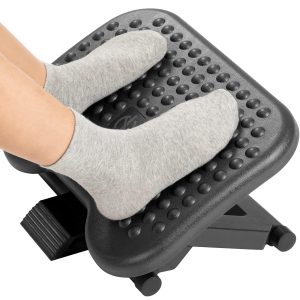
- Adjustable height and angle: Look for a foot rest that tilts to accommodate different sitting positions. A 20-30 degree angle is ideal for promoting circulation.
- Non-slip surface: Your feet should stay put, not slide off. Rubberized or textured surfaces provide grip.
- Stability: A heavy-duty base prevents tipping or sliding on carpet or hard floors.
- Size: Choose a wide enough platform to allow foot movement — roughly 18 x 12 inches is standard.
At Slowvana, our ergonomic foot rests are designed with desk workers in mind. They feature adjustable angles, non-slip surfaces, and a sturdy build that supports natural foot placement. But remember: the best foot rest is the one you’ll actually use consistently.
Setting Up Your Desk for Maximum Foot Rest Benefits
Even the best foot rest won’t help if your overall setup is off. Here’s a quick checklist:
- Chair height: Adjust so your hips are level with or slightly above your knees when feet are on the foot rest. Your thighs should be parallel to the floor.
- Foot rest placement: Position it so your feet rest flat, with your knees at a 90-100 degree angle. Avoid tucking the foot rest too far under the desk.
- Monitor height: Your eyes should be level with the top third of the screen. Use a monitor stand if needed.
- Keyboard position: Your elbows should be at 90 degrees, with wrists straight. A wrist rest can help maintain neutral alignment.
- Take breaks: Even with perfect ergonomics, stand and stretch every 30-60 minutes. A foot rest is a tool, not a cure-all.
Common Myths About Foot Rests
Let’s debunk a few misconceptions:
- Myth: Foot rests are only for short people. Truth: Anyone whose chair height prevents flat-footed sitting can benefit. Tall people often need foot rests too, especially if their desk is at a fixed height.
- Myth: A foot rest is unnecessary if you have a good chair. Truth: Even the best chair may not accommodate your unique leg length. A foot rest personalizes your setup.
- Myth: Foot rests are only for people with pain. Truth: Prevention is key. Using a foot rest proactively can prevent future discomfort and improve circulation.
Expert Insights: What Ergonomists Say
Dr. Karen Jacobs, a clinical professor of occupational therapy at Boston University and former president of the American Occupational Therapy Association, emphasizes: “Foot support is a non-negotiable component of a healthy seated workstation. It reduces pressure on the lower back and promotes neutral posture. I recommend a foot rest for almost all my desk worker clients.”
Similarly, a 2021 study in Work: A Journal of Prevention, Assessment & Rehabilitation found that participants who used an ergonomic foot rest for four weeks reported significant reductions in lower back pain and improved comfort scores compared to a control group.
Foot Rest Benefits Beyond the Desk
The advantages of proper foot support extend into your personal life. Better posture at work can reduce evening fatigue, improve sleep quality, and decrease the risk of chronic musculoskeletal conditions. By investing in a foot rest, you’re not just solving a workday problem — you’re supporting your long-term health.
Slowvana’s recovery lifestyle philosophy is rooted in this idea: small, intentional changes to your workspace can yield profound benefits for your body and mind. A foot rest is one of the simplest, most cost-effective upgrades you can make.
Take Action Today
You don’t need to overhaul your entire office to feel better. Start by checking your chair height. If your feet don’t rest flat on the floor — or if you find yourself crossing your legs or tucking your feet — it’s time for a foot rest.
Browse Slowvana’s collection of ergonomic foot rests, designed to support your recovery at work. With adjustable angles, non-slip surfaces, and a focus on comfort, they’re the perfect addition to any desk setup.
Your feet (and your back) will thank you.
🪑 Fix Your Desk Setup in 5 Minutes
Download the free Ergonomic Setup Checklist — 15 steps to reduce pain and work comfortably.
Get Free Checklist →