The link between The Connection Between Posture and Stress and What Science Says (And How to Fix Both) directly affects desk worker health. Understanding this relationship helps you address the root cause rather than just treating symptoms.
You Feel Stressed. But Is Your Posture Making It Worse?
You’re hunched over your keyboard, shoulders rolled forward, neck craning toward the screen. Your jaw is tight. Your breathing is shallow. And you feel… stressed. Overwhelmed. Maybe even a little anxious.
You probably assume it’s the workload. The deadlines. The endless Slack notifications.
But what if I told you that your posture — the way you’re sitting right now — is actively fueling that stress response? And that by simply changing how you hold your body, you could actually lower your stress levels?
This isn’t wellness woo. It’s backed by neuroscience, endocrinology, and biomechanics. Let’s dive into the science of the posture-stress loop — and how you can break it.
The Posture-Stress Feedback Loop: A Two-Way Street
Most people think posture is just about alignment — straight back, squared shoulders, chin tucked. But posture is also a signal. It’s how your body communicates with your brain.
When you’re stressed, your body naturally adopts a protective, collapsed posture — shoulders rounding inward, head dropping forward, chest caving. This is the classic “fetal position” of the seated worker. It’s your nervous system’s way of saying, “I’m under threat. Protect the vital organs.”
But here’s the kicker: the reverse is also true.
When you deliberately adopt a collapsed, slouched posture — even without feeling stressed — your brain interprets it as a sign of threat or defeat. This triggers a cascade of physiological stress responses.
“Posture is not just a reflection of your emotional state — it’s a driver of it. The body and mind are in constant, bidirectional communication.” — Dr. Amy Cuddy, social psychologist and author of Presence
What Science Says: The Cortisol Connection
Cortisol is your body’s primary stress hormone. It’s essential for survival — it gives you the energy to flee from danger. But when cortisol stays chronically elevated (hello, modern desk life), it wreaks havoc: anxiety, brain fog, weight gain, poor sleep, and weakened immunity.
So what does posture have to do with cortisol?
The 2017 Study That Changed Everything
A landmark study published in the Journal of Psychophysiology (Nair et al., 2017) examined how posture affects cortisol levels. Participants were asked to adopt either a “slouched” or “upright” seated posture while completing a stress-inducing task (a mock job interview and math test).
The results were striking:
- Slouched participants showed significantly higher cortisol levels after the stress task.
- Upright participants had lower cortisol reactivity and reported feeling more confident and less fearful.
- Slouchers also used more negative emotion words when describing their experience.
In other words: sitting up straight doesn’t just make you look more confident — it actually changes your hormonal response to stress.
The Biomechanics of Breathing
Here’s another piece of the puzzle: when you slouch, you compress your diaphragm. Your rib cage collapses inward. Your lungs can’t fully expand.
The result? Shallow, rapid, upper-chest breathing. This is the exact breathing pattern associated with the fight-or-flight response.
When you sit upright — with your shoulders back, chest open, and spine elongated — your diaphragm has room to move. You naturally breathe deeper and slower. This activates the vagus nerve, which signals your parasympathetic nervous system (the “rest and digest” mode) to take over.
The Psychological Impact: Power Posing and Self-Perception
You’ve probably heard of “power posing” — the idea that expansive postures (like standing tall with hands on hips) can boost confidence and lower stress. While some of the original claims have been debated, the core insight remains valid: your posture influences how you feel about yourself.
A 2018 meta-analysis in Psychological Bulletin found that upright posture consistently led to higher self-esteem, better mood, and lower anxiety compared to slumped posture. The effect was small but reliable.
Think about it: when you’re feeling stressed at your desk, do you tend to shrink? Hunch? Make yourself smaller? That’s not just a symptom — it’s a behavior that reinforces the stress.
The Embodied Cognition Framework
This is called embodied cognition — the theory that your mental processes are shaped by your physical body. Your posture doesn’t just reflect your emotions; it creates them.
When you sit upright, you’re telling your brain: “I am alert. I am capable. I am safe.” When you slouch, you’re saying: “I am defeated. I am tired. I am under threat.”
Breaking the Cycle: How to Use Posture to Reduce Stress at Work
Here’s the good news: you don’t need a complete office overhaul or an expensive ergonomic consultation. Small, intentional changes can shift both your posture and your stress levels.
1. Set Up for Success: Desk Ergonomics 101
Your environment shapes your posture. If your screen is too low, you’ll naturally crane your neck forward. If your desk is too high, you’ll shrug your shoulders. If your chair is too deep, you’ll slouch.
Start with the basics:
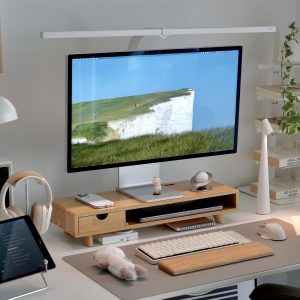
- Monitor height: The top of your screen should be at or slightly below eye level. A monitor stand can help you achieve this without stacking books.
- Keyboard position: Your elbows should be at a 90-degree angle, wrists straight. A wrist rest can prevent the “broken wrist” position that strains your forearms and shoulders.
- Feet flat: Your feet should rest flat on the floor or on a foot rest. When your feet dangle, your hips rotate backward, collapsing your lower back.
- Lumbar support: A lumbar cushion helps maintain the natural curve of your spine, preventing the slouch that triggers your stress response.
2. The 5-Minute Posture Reset
Every hour, take 5 minutes to reset your posture. Here’s a simple sequence you can do at your desk:
- Roll your shoulders back and down. Imagine your shoulder blades sliding into your back pockets.
- Lengthen your spine. Imagine a string pulling you up from the crown of your head.
- Tuck your chin slightly. This aligns your ears over your shoulders.
- Take 5 deep breaths. Inhale for 4 counts, exhale for 6. Feel your rib cage expand.
That’s it. Do this every hour, and you’re not just fixing your posture — you’re resetting your nervous system.
3. Use Breathing as a Bridge
Breathing is the fastest way to shift from stress to calm. And posture makes it easier or harder.
Try this: slouch forward and take a deep breath. Notice how shallow it feels. Now sit up tall, open your chest, and breathe again. Feel the difference?
When you feel stress rising at your desk, first adjust your posture, then breathe. The combination is more powerful than either alone.
4. Stand Up (Literally) to Stress
Prolonged sitting is not just bad for your back — it’s bad for your mood. A 2018 study in Mental Health and Physical Activity found that standing breaks reduced fatigue and improved energy levels in desk workers.
If you can, alternate between sitting and standing throughout the day. Even 5 minutes of standing every hour can disrupt the posture-stress loop.
Real-World Results: What Slowvana Users Say
We’ve seen this transformation firsthand. Sarah, a remote marketing manager, came to us with chronic neck pain and daily anxiety. After adjusting her monitor height with a Slowvana monitor stand and adding a lumbar cushion, she noticed something unexpected:
“I thought the stress was all in my head. But when I fixed my posture, I realized how much of it was in my body. I feel calmer, more focused, and my shoulders don’t ache anymore.”
This isn’t just anecdotal. When you remove the physical strain of poor posture, your brain has fewer pain signals to process. Less pain = less stress. It’s that simple — and that profound.
Your Action Plan: From Slouch to Strength
Here’s a quick summary of what you can do today:
| Action | Why It Helps | Time Investment |
|---|---|---|
| Raise your monitor to eye level | Prevents forward head posture that triggers stress | 30 seconds |
| Add lumbar support to your chair | Maintains spine curve, reduces slouching | 1 minute |
| Use a foot rest | Keeps hips aligned, prevents lower back collapse | 30 seconds |
| Take 5 deep breaths upright | Activates vagus nerve, lowers cortisol | 1 minute |
| Stand for 5 min every hour | Breaks the sitting-stress cycle | 5 min/hour |
The Bottom Line: Your Posture Is a Stress Lever
You can’t always control your workload. You can’t always control your deadlines. But you can control how you sit.
And science is clear: changing your posture changes your brain chemistry. It lowers cortisol. It deepens your breath. It signals safety to your nervous system.
So the next time you feel stress creeping in at your desk, don’t just reach for another coffee or doom-scroll through your phone. Check your posture first.
Straighten your spine. Open your chest. Breathe.
You might be surprised at how much lighter everything feels.
Ready to build a stress-reducing workspace? Explore Slowvana’s ergonomic essentials — monitor stands, wrist rests, foot rests, and lumbar cushions — designed to support your body and calm your mind.
🎯 Free: 5-Minute Ergonomic Desk Setup Checklist
You just read about fixing your desk setup. Now put it into action. Our 15-step checklist covers monitor height, keyboard position, chair setup, and more — all in under 5 minutes.
🪑 Fix Your Desk Setup in 5 Minutes
Download the free Ergonomic Setup Checklist — 15 steps to reduce pain and work comfortably.
Get Free Checklist →